
EC-6 ESL Lesson Plan Format – Science
Background Information
- Content Area: Science
- Topic: Forms of Energy
- Grade: 3rd Grade
Goals and Objectives
- TEKS:
Science- 3.6– Force, motion, and energy. The student knows that forces cause change and that energy exists in many forms. The student is expected to: (A) explore different forms of energy, including mechanical, light, sound, and thermal in everyday life.
Art- 3.2– Creative expression. The student communicates ideas through original artworks using a variety of media with appropriate skills. The student expresses thoughts and ideas creatively while challenging the imagination, fostering reflective thinking, and developing disciplined effort and progressive problem-solving skills. The student is expected to: (A) integrate ideas drawn from life experiences to create original works of art;
- Content Objective:
The students will identify the four forms of energy covered with 90% accuracy. The students will create a piece of art that represents a form of energy covered during the science lesson.
- ELPS:
3D- Speak using grade-level content area vocabulary in context to internalize new English words and build academic language proficiency.
- Language Objective:
The students will speak using the words, energy, mechanical energy, light energy, sound energy and thermal energy. The students will use the words and give examples of each with a 90% accuracy.
- Materials Needed:
- Technology Needed:
Pre-Assessment related to TEKS and Objectives
The teacher will present four pictures on the interactive white board. One of a bull dozer moving dirt, one of the sun, one of a hot spring steaming and one of someone listening to music. The teacher will tell the students that each picture represents a form of energy. She will ask the students what energy is and see if they can answer what energy each picture represents. This will tell the teacher what the students already know and what they do not know concerning the topic of energy.
Key Vocabulary:
- Energy
- Mechanical Energy
- Thermal Energy
- Light Energy
- Sound Energy
 Instructional Procedures
This section must include the instructional procedures. Below is an example of what this would look like for an inquiry-based, 5E learning cycle.
- Engage
- The teacher will continue with the same pictures that were included in the pre-assessment but she will begin showing the children what each picture represents. She will uncover the words on the interactive white board to show that the bull dozer represents mechanical energy, the sun represents light energy, the hot springs that were steaming represents thermal energy and the person listening to the music represents sound energy. The teacher will allow the children to do a 90 second spark and talk with a partner about different ways to show the four forms of energy.
- Purpose of the Engage is to:
- Focus the student’s attention on the lesson
- Create an organizing of the framework for the ideas, principles, or information that is to follow
- Refer to prior learning
- Explore
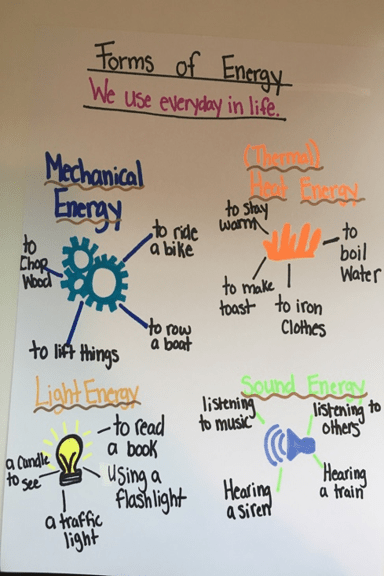
- The teacher will complete an anchor chart like the one included below. She will guide the students learning in connecting each form of energy to everyday tasks. The teacher will add the tasks the students’ say to help increase the student knowledge about energy. The teacher will write out the new vocabulary as well as draw pictures on the anchor chart to help ELL’s as well as all students who need visual support. The teacher will encourage the children to talk about the forms of energy using the academic vocabulary.
I created this anchor chart.
- Explain
The student will complete a flip chart that will go in their science journals. The student’s will be expected to illustrate a picture representing each form of energy in their individual lives. Underneath each flap the students will write the definition of the energy form in a complete sentence. This activity will be finished as a whole group. The teacher will use the document camera and fill in the chart based on the children’s responses. The teacher will write down everyone’s idea but the students only have to write down their ideas.
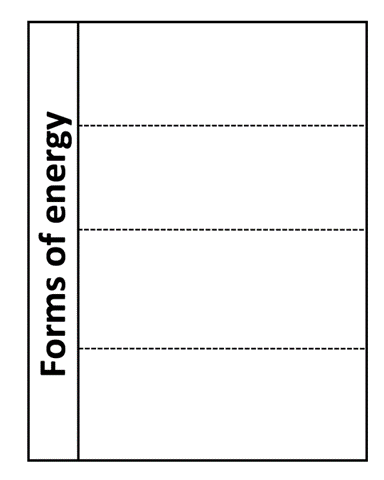
I created this flipbook.
- Elaborate
For this section I will check for understanding of the topic by using Costas 3 levels of questioning.
Level 1- What are the four types of energy we learned about today? List two examples of each form of energy.
Level 2- Compare and contrast light energy with heat energy. Compare and contrast mechanical energy with sound energy.
Level 3- Create a situation where more than one form of energy is used. Illustrate a picture showing what is happening in the scenario created.
- Re-Teaching
- If I have students struggling with the concept of forms of energy, I will complete a whole group re-teach. I will have four cards labeled with words and an illustration of the four types of energy. I will have scenarios/situations listed on the other cards and we will find where each card belongs. This matching game will help the children have a deeper understanding of the different forms of energy because it will provide visual support.
- Modifications
- For children with an IEP or special needs I will abide by their plans and follow all modifications for each child.
- For ELL’s at the speaking beginning level I wouldn’t require that they speak out loud in the class discussion or the creating of the anchor chart. I would however, encourage them and praise them for speaking. For the intermediate level, I would encourage more processing time when participating in group discussions and the completion of the flip book. For the advanced and advanced high levels, I would set them up to use the new vocabulary words learned, as well as when participating in the flip book activity I would encourage them to speak using the academic vocabulary words. I would also encourage the advanced and advanced high levels to speak in different parts of the lesson which would allow them more practice bit also model for the lower children.
- Extensions
- The children will have the choice to get on a computer and complete some forms of energy games on BrainPop. They may also illustrate a picture with the different forms of energy labeled. They will also have the option to read their individual books or complete a puzzle independently.
Assessment
- Evaluate
- For the assessment, the teacher will look over the children’s completed flip books and monitor their understanding over the different forms of energy. However, the teacher will complete a mini assessment for this lesson using the individual whiteboards. Each child will have a board and a marker, the teacher will ask the children to write down the form of energy that provides heat as well as give 3 examples. The teacher will then ask them to write down the form of energy that is needed to ride a bike. The teacher will ask them to write down 3 reasons that light energy is needed and how we use it every day. Lastly, the teacher will ask the students to define sound energy and provide an illustration of how it is used.
- The teacher will be taking anecdotal notes during the whiteboard activity and mastery will be measured at 95%.
- The students display their knowledge and understanding of the different forms of energy by completing the lip book. The children also worked cooperatively during the flip book activity.
- The students listened and followed directions during the re-teach matching game as well as the mini assessment
Summary for the Students of What Has Been Learned
- Closure
- The teacher will bring the class back together and start talking about the vocabulary learned, and how we can determine when different forms of energy are being used. However, there are some events when more than one form of energy is being used. As a class, we will discover some of those events, such as when you kick a soccer ball, you use mechanical energy but the sound that is created when the ball meets the foot is sound energy. The teacher will also ask the students to rate their learning with a thumb up, thumb horizontal or a thumb down. This final check will let the teacher know where the students stand.
References
Flip Into Success ELPS at a Glance. (2009). El Saber Enterprises.
Texas Education Agency, 2010. TEKS. Retrieved from: http://ritter.tea.state.tx.us/rules/tac/chapter112/ch112a.html
 3ScienceLadies