
EC-6 ESL Lesson Plan – Science
Background Information
- Content Area: Science
- Topic: Friction
- Grade: 4th grade
- Goals and Objectives
- TEKS 4.6 (D) design a descriptive investigation to explore the effect of force on an object such as a push or a pull, gravity, friction, or magnetism.
TEKS 4.2 (C) construct simple tables, charts, bar graphs, and maps using tools and current technology to organize, examine, and evaluate data;
- Content Objective:
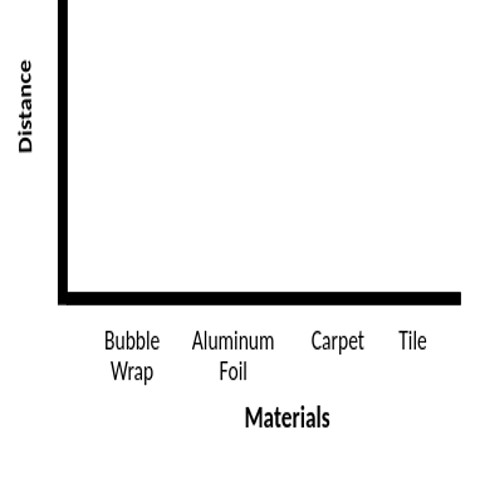
The fourth-grade science students will design a bar graph to represent the relationship between the friction and the distance of a toy car using the results of the experiment.
- ELPS:
ELPS 74.4 (c) 3 (E) share information in cooperative learning interactions
- Language Objective:
The fourth-grade science students work cooperatively in small groups while sharing learned knowledge to create the bar graph.
- Materials Needed:
- Graph Sheet (for each student) (Appendix A)
- Aluminum foil sheet (one per group)
- Toy car (one per group)
- Carpet piece (one per group)
- Tile (one per group)
- Bubble wrap (one per group)
- Design a Racetrack! (for each student) (Appendix B)
- Technology Needed:
- Projector
- Pre-Assessment related to TEKS and Objectives
The students will be asked to tell what friction is in their own words. Then they will be asked to predict which material will allow the car to travel the furthest using with the most friction. They will put the four materials in order from most friction to least as a class. We will post this on the wall and compare this at the end of the lesson. (This will be done after the hook.)
- Key Vocabulary:
| Friction | Toy Car | Bubble Wrap |
| Aluminum Foil | Carpet | Tile |
| Distance | Material | Associations |
- Instructional Procedures
- Engage
The teacher will write the word “FRICTION” on the board and hold up a toy car. Then ask the students how to explain the word and toy car are associated. There are guiding questions to lead them in the right directions, such as “does the car always go the same distance on any material?” Why or why not?
- Explore
- The students will be put into groups and given their materials for this experiment.
- Teacher Modeling: The teacher will model how to set up the experiment by having an example for the students to follow. The teacher will push a toy car across the aluminum foil. The teacher will take notes on how far the car traveled using this material.
- Guided Practice: The teacher will complete another example, but this time she will have a student come up to do the movements with the teacher’s guidance.
- Checking for Understanding: The students will do this with all four materials as a group. When they finish driving the car across all four materials, then the students will be completing the graph to show the distance that the car traveled.
- Explain
- The students will go around the room and compare their graphs with other groups’ graphs for 2 minutes. Then we will discuss this as a class. The teacher will then clarify any misconceptions or correct any reoccurring mistakes.
- Checking for Understanding: The teacher will ask how students will do with other materials at their homes. Will a car going across a kitchen counter or grass create more friction?
- Elaborate
- The students will create a racetrack where they choose which materials they would like to use for the track itself. They would have to choose one of the four materials for the track or a mix of the materials. They will have to include a drawing of the car on the track, the stands, the track, the type of material that they used for the track, and the reason that they chose this material for the track. (Appendix B)
- Re-Teaching
- I would have the students group multiple pictures printed out with a possible graph to describe how far the car would travel, similar to the graph that they completed in class. The students will have to match the material to the graph. (Appendix A)
- Modifications
- We could do another example in class if the students do not understandably we go.
- For ELs I would include sentence stems, visual aids, a picture of the materials with their name labeled across them, and the written questions to allow them to see and hear the information.
- Include images along the x-axis along with the listed materials.
- Extensions
- The students will compare two different materials that they could try to drive a toy car over to compare materials. Some examples could be a piece of paper, notebook, desk, concrete, playground wood chips, basketball court, rug, etc. They could do the same experiment wi other materials that could be found around the school.
- The students could measure the distance exactly to be more exact with their graphs.
- Assessment
- Evaluate –
- During the lesson, the teacher can assess the students by examining their graphs as they create them. The teacher can see how the students understood the association between traveled distance and friction.
- If the students were engaged constantly and actively participating in the group conversations, then they will have a positive assessment for the materials. If they contribute to the conversations with accurate information, then the teacher can assume that they understand the TEKS, but if they are confused or struggling the teacher needs to contribute more information or guidance.
- The teacher can see the students’ individual assessments by checking the racetrack assignment to see if they were able to follow the directions and explain the reasoning for choosing their materials. If the students was able to choose a material and accurately describe the material in their explanation, then the student has mastered the content. If not, then the teacher needs to reteach the lesson.
- Summary for the Students of What Has Been Learned
- Closure – We will have the students group by materials. The students who chose aluminum foil will be in a group, the students who chose carpet together, etc. Then as a class we will discuss the pros and cons of these materials. The teacher will make sure to emphasize the relationship between friction and distance.
References
Texas Education Agency, 2010. TEKS. Retrieved from:
http://ritter.tea.state.tx.us/rules/tac/chapter112/ch112a.html
Texas Education Agency, 2010. ELPS. Retrieved from: http://ritter.tea.state.tx.us/rules/tac/chapter074/ch074a.html
Appendix A
Graph Sheet
Appendix B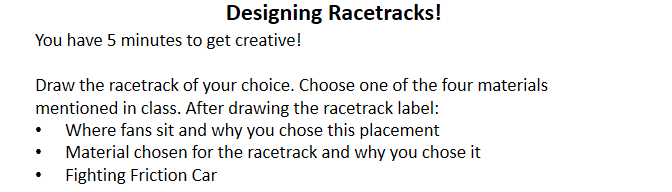
 3ScienceLadies