
EC-6 ESL Lesson Plan– Science
- Background Information
- Content Area: Science
- Topic: Weather Tools
- Grade: 2nd Grade
Goals and Objectives
- TEKS
(4) Scientific investigation and reasoning. The student uses age-appropriate tools and models to investigate the natural world. The student is expected to:
(A) collect, record, and compare information using tools, including computers, hand lenses, rulers, plastic beakers, magnets, collecting nets, notebooks, and safety goggles or chemical splash goggles, as appropriate; timing devices; weather instruments such as thermometers, wind vanes, and rain gauges; and materials to support observations of habitats of organisms such as terrariums and aquariums; and
(8) Earth and space. The student knows that there are recognizable patterns in the natural world and among objects in the sky. The student is expected to:
(B) identify the importance of weather and seasonal information to make choices in clothing, activities, and transportation; and
- Content Objective:
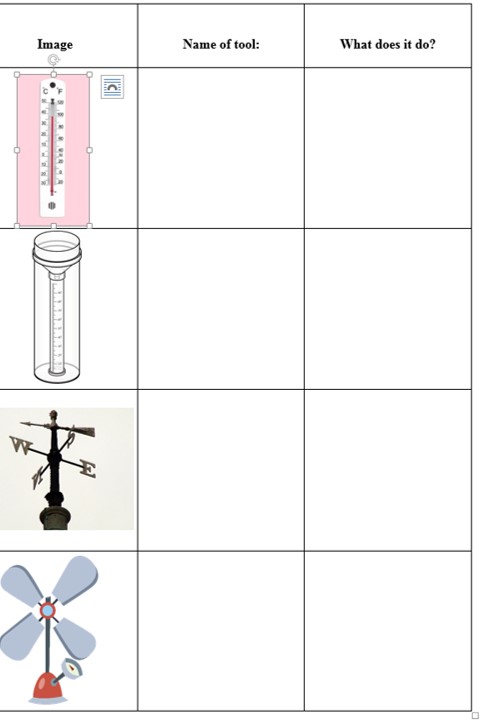
Students will be able to accurately identify all four weather measuring tools and describe what they are used for.
ELPS:
(5) Cross-curricular second language acquisition/writing. The ELL writes in a variety of forms with increasing accuracy to effectively address a specific purpose and audience in all content areas. ELLs may be at the beginning, intermediate, advanced, or advanced high stage of English language acquisition in writing. In order for the ELL to meet grade-level learning expectations across foundation and enrichment curriculum, all instruction delivered in English must be linguistically accommodated (communicated, sequenced, and scaffolded) commensurate with the student’s level of English language proficiency. For Kindergarten and Grade 1, certain of these student expectations do not apply until the student has reached the stage of generating original written text using a standard writing system. The student is expected to:
(B) write using newly acquired basic vocabulary and content-based grade-level vocabulary;
4. Language Objective: Students will complete a graphic organizer by accurately writing the names of the tools and providing their appropriate descriptions.
5. Materials Needed: Slide show, graphic organizer handout, headbands, index cards
6. Technology Needed: Projector
- Pre-Assessment related to TEKS and Objectives
I will engage in prior knowledge by referring to a book the students have recently read in class, Superstorms by Seymour Simon. Then, I will ask the class if they have ever heard of weather instruments and call on students to share what they know.
- Key Vocabulary:
- Thermometer
- Rain gauge
- Wind vane
- Anemometer
- Precipitation
- Instructional Procedures
- Engage
- I will present a slide show by Study Jams called Weather Instruments from Scholastic.
- Link: http://studyjams.scholastic.com/studyjams/jams/science/weather-and-climate/weather-instruments.htm
- I will call on students to name weather instruments they can recall from the slideshow.
- To give a visual, I will display a weather station beneath the projector and call on students to identify and describe the four weather instruments.
- I will say the name of each weather instrument and ask the students to repeat it back to me.
- Purpose of the Engage is to:
- Focus the student’s attention on weather and the tools we use to measure weather.
- Explore
- The students will work in partners and participate in an activity where they will be using headbands and premade index cards that have each of the four instruments represented on them. (The name of the instrument and an image will be on the front of the card, and its description will be on the back.) The teacher will draw sticks to pair students up.
- Each group will have one plastic headband, four index cards and a card with question examples and sentence stems.
- The students will take turns guessing what card is on their forehead by asking their group members “yes or no,” questions.
- Once the student correctly guesses what tool they have, they will take it off of their forehead and read the description of the tool on the back of the card to their partner. When each tool is covered, the activity is completed and can be repeated a second time.
- If groups finish before their peers, they will quiz each other with the cards by either taking turns reading the descriptions and asking their partner to name the instrument, or vice versa.
- Teacher Modeling: The teacher will explain the instructions of the activity and set expectations.
- The teacher will model how to place the headband on their head, how to place the card in it and use the sentence stems provided to ask questions to guess what their card says.
- Some examples:
- Do I measure_________(precipitation, wind, temperature)?
- Can I be used during the __________(fall, winter, summer, spring) season?
- “The headbands should be handled appropriately, not as a whip to swing in the air or hit anyone. Also, the cards should be taken care of and not thrown around because they can hit someone in the eye or give someone a papercut.”
- Some examples:
- Guided Practice: The teacher will be walking around and assessing students by checking to see how quickly they are able to guess their instrument and listen to see what type of questions they are asking to identify their level of understanding. The teacher will give guidance if needed.
- The teacher will model how to place the headband on their head, how to place the card in it and use the sentence stems provided to ask questions to guess what their card says.
- The students will work in partners and participate in an activity where they will be using headbands and premade index cards that have each of the four instruments represented on them. (The name of the instrument and an image will be on the front of the card, and its description will be on the back.) The teacher will draw sticks to pair students up.
- Explain
- Once the activity is complete, the students will each receive a weather instrument graphic organizer to complete individually. At this time, the students will be told to “put up their office,” and be reminded not to speak to one another.
- Images of the instruments are provided for them on the handout, the students are to write the tool’s name and explain what it does.
- A word bank of the instrument names will be projected on the screen for reference
- Students will turn in the graphic organizer when they are finished.
- Checking for Understanding:
- Bloom’s Taxonomy Lower-level thinking question:
- What are the names of the four weather instruments we learned about today?
- Bloom’s Taxonomy Intermediate-level thinking question:
- How is a wind vane different from an anemometer?
- Bloom’s Taxonomy Higher-level thinking question:
- If I needed to decide whether or not I should grab a jacket tonight, describe what weather tool I might use to help me make my decision? Why?
- Elaborate
- The teacher will facilitate a class discussion over the use of these tools in everyday life and guide students to make real life connections by describing different occupations that rely on these tools and/or by sharing personal experiences.
- Re-Teaching
- In small groups or as an entire class, students will watch video animations of each tool and will need to turn and talk to another classmate and describe what they saw. Next, the teacher will say the name of the tool, and the students will repeat the name back to the teacher. After that, the teacher will model and guide the students to draw the tool and write down its name. Then, the teacher will give a short description of what the tool does, and the students will turn and tell a partner what it does. This process will continue until all four of the tools are covered. Also, at this time, students may ask questions.
- Then students will receive a handout with the names of the instruments and their descriptors in different boxes, which they will cut out. Then the students will work individually to accurately match the cards. The teacher will walk around and check each student’s work.
- Once the cards are matched correctly, each student will complete a handout where they must draw a line to match the name of the tools to their description without using their study cards.
- Modifications
- Special needs/IEP: Pre-made study cards with labels and images printed in color. Assistance from an interventionalist or Teacher’s aide. Personal printed copy of slide show. Provided with access to video animations with headphones to hear audio. Provided with cut-and-paste tool name and definition cards to be placed into an organizer.
- Beginners: Pre-made study cards with labels and images printed in color. Assistance from an interventionalist or Teacher’s aide. Provided with cut-and-paste tool name and definition cards to be placed into an organizer.
- Intermediate: Work with a partner.
- Advanced English learners (ELs): Option to work with a partner.
- Extensions
- How might you extend this lesson for children of more advanced abilities?
- These students will create comic strips that will identify at least one weather element, one weather tool and what clothes are appropriate to wear in those conditions.
- How might you extend this lesson for children of more advanced abilities?
- Then students will receive a handout with the names of the instruments and their descriptors in different boxes, which they will cut out. Then the students will work individually to accurately match the cards. The teacher will walk around and check each student’s work.
- In small groups or as an entire class, students will watch video animations of each tool and will need to turn and talk to another classmate and describe what they saw. Next, the teacher will say the name of the tool, and the students will repeat the name back to the teacher. After that, the teacher will model and guide the students to draw the tool and write down its name. Then, the teacher will give a short description of what the tool does, and the students will turn and tell a partner what it does. This process will continue until all four of the tools are covered. Also, at this time, students may ask questions.
- Bloom’s Taxonomy Lower-level thinking question:
- Once the activity is complete, the students will each receive a weather instrument graphic organizer to complete individually. At this time, the students will be told to “put up their office,” and be reminded not to speak to one another.
- Assessment
- Evaluate – Students will be assessed by their completion of their graphic organizers. Each tool should be appropriately named and defined (spelling does not count, although a word bank of tool names will be provided.)
- What did the students do during this lesson to let you know they had met the objectives stated above?
- Students will have completed their graphic organizers with 100% accuracy.
- What were the behaviorally/observable ways that the students met the objectives for this lesson?
- Students will be actively participating in the activities and class discussions.
- What did the students do during this lesson to let you know they had met the objectives stated above?
- Summary for the Students of What Has Been Learned
- Closure – “Today we discussed what weather instruments we can use to measure weather elements such as precipitation, wind and temperature. These tools can also help us understand how we should dress for the day and help us predict what we might experience throughout the day as well. Since weather is something we cannot control, it is important for us to understand how to be prepared for it and these tools can help us do that.”
References
English Language Proficiency Standards. Chapter 74, Curriculum Requirements.
Subchapter A. Required Curriculum. Chapter 74.4, c, 2,i
Texas Essential Knowledge and Skills for Social Studies. Subchapter A. Elementary,
Chapter 112.13, b, 4, A. Retrieved from http://ritter.tea.state.tx.us/rules/tac/chapter112/ch112a.html#112.13
Texas Essential Knowledge and Skills for Social Studies. Subchapter A. Elementary,
Chapter 112.13, b, 8, B. Retrieved from http://ritter.tea.state.tx.us/rules/tac/chapter112/ch112a.html#112.13
 3ScienceLadies